Education

Anion Exchange - Columns

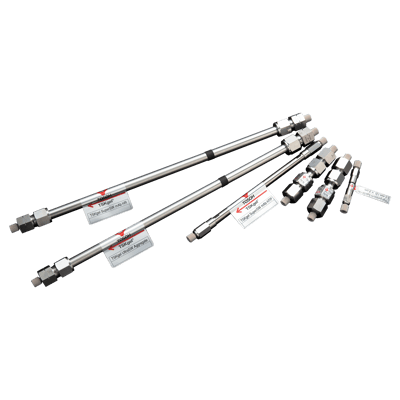
Very efficient chromatography can be achieved with the nonporous TSKgel STAT columns due to the novel bonding chemistry and the absence of micro-pores. Applications for the TSKgel Q-STAT columns include the separation of proteins, peptides, low molec...

MCC Applications

In general multi-column chromatographic systems are typically used for bulk separations (oils ...) or end product purification (e.g. chiral separations) and are sometimes used in series (first bulk, than fine).The Octave™ systems can be used for a va...

Benefits of MCC

Multi-column chromatography results in higher productivity due to higher load levels, faster flowrates, and parallelization of non-loading steps.Multi-column chromatography provides the following benefits:Reduced resin consumption (cost savings)Incre...

Holistic Multi-Column Chromatography Solution

Multi-column chromatography is a liquid chromatographic technique used to purify solutions via a cyclic usage of multiple columns that is faster and more cost-effective than batch chromatography.The Octave™ MCC platform is designed to purify biomolec...

Introduction to the Multi-Column Technique

MCC can be run continuously and intensifies the chromatography step, compared to batch chromatography.Compared to an injection of a distinct sample volume onto a comparably large column as done in classic batch- or single-column chromatography, MCC t...

Multi-Column Chromatography (MCC)

Multi-column chromatography (MCC) is an innovative downstream processing (DSP) method for the purification of biological targets.MCC can be run continuously and intensifies the chromatography step, compared to batch chromatography. This is accomplish...

SEC columns – the tool for size exclusion chromatography

All chromatography columns that separate mixtures of molecules by size are SEC columns. They consist of a column housing filled with porous particles that are responsible for the retention of molecules of different sizes contained in a sample and thu...

Chromatography Experts, Ep. 5: Exploring Chromatography Resin Selection

Episode Title:Exploring Chromatography Resin SelectionIn This Episode:In this episode, we dive into selecting the right chromatography resins for bioprocessing applications and how important it is to have a trusted vendor in today’s market.🎙️ Join o...

Chromatography Experts, Ep. 4: Viral Clearance in Bioprocessing - MCC

Episode Title:Viral Clearance in Bioprocessing: MCC EditionIn This Episode:In this episode of the Chromatography Experts Podcast, we take a closer look at viral clearance in Multi-Column Chromatography and why it matters.Marissa Heino and Abbie Breto...

A Closer Look at Size Exclusion Chromatography (SEC) in Bioprocessing

Unleashing the Power of Size Exclusion Chromatography (SEC) in BioprocessingSize Exclusion Chromatography (SEC), also known as gel filtration chromatography, is a cornerstone technique in the biopharmaceutical industry, prized for its ability to sepa...

Chromatography Experts, Ep. 3: Shedding Light on MALS

Episode Title:Shedding Light on MALSIn This Episode:Shedding light on MALS! In Episode 3 of our Chromatography Experts podcast, Phu Duong, Ph.D., sits down with special guest Tianyu Li, Ph.D., to unpack the power of Multi-Angle Light Scattering (MALS...

Chromatography Experts, Ep. 2: Exploring Chromatography Resin

Episode Title:Beyond the Beads: Exploring Chromatography ResinIn This Episode:Join our #ChromatographyExperts as they explore the science behind chromatography resins — from key terminology and applications to what sets different resins apart, and ho...

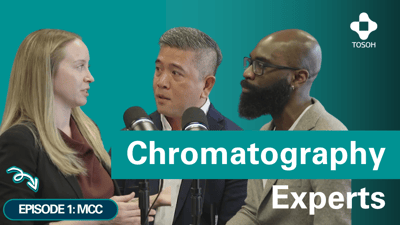
Chromatography Experts, Ep. 1: Multi-Column Chromatography (MCC)

Episode Title:MCC - How it work's and what's nextIn This Episode:Multi-Column Chromatography (MCC) is changing everything. But what exactly is MCC? How does it compare to traditional batch methods, and where is it taking bioprocessing next? Our #Chro...
Back to top