
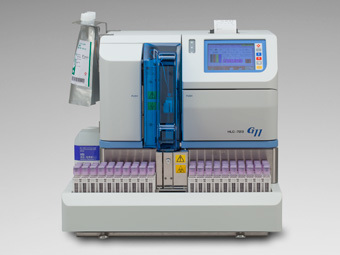
HLC-723G11
Fully automated HPLC analyzer based on ion-exchange chromatography method for measurement of HbA1C and screening of β-thalassemia.
Part #: 0023850
Manufacturers:
Description
The Tosoh HLC-723G11 is a high-performance liquid chromatography (HPLC) analyzer designed for the automated and efficient analysis of hemoglobin components in clinical settings. Utilizing ion-exchange chromatography, the system separates hemoglobin components in whole blood with precision. Equipped with non-porous TSKgel® column, the HLC-723G11 delivers clear resolution, enabling true separation of various hemoglobin components and variants. This versatile system provides a diagnostic solution for the measurement of Hemoglobin A1C (HbA1C) and the diagnosis of thalassemia, supporting both routine and specialized laboratory testing.
Variant Analysis Mode – HbA1C Measurement
HLC-723G11 employs an ion-exchange chromatography method to separate and quantify HbA1C, a key marker of diabetes diagnosis, from other hemoglobin variants such as HbS, HbC, HbD and HbE. The TSKgel® column, with its non-porous resin, ensures the true physical separation of stable HbA1C and labile HbA1C, in just a minute. The system adheres to international standards, including those set by the IFCC and NGSP, ensuring the accuracy for both diagnosis and monitoring of diabetes. This makes it an essential tool for clinicians in tracking long-term glycemic status of patients.
β-Thalassemia Mode – Thalassemia Diagnosis
HLC-723G11 helps in the separation and quantification of HbA2 and HbF, hemoglobin variants that are crucial in diagnosis of thalassemia and other hemoglobinopathies. The system is facilitated by non-porous TSKgel® column which provides quantitative measurements of HbA2 and HbF within five minutes. This column ensures the high-resolution separation of HbA2 from HbE, where elevated HbA2 levels are a key indicator for diagnosing β-Thalassemia. Thus, HLC-723G11 enables clinicians to diagnose thalassemia with confidence, supporting informed patient management and genetic counselling.
Features
- Based on gold standard HPLC technology
- Fully automated analyzer minimizes operator intervention
- Stable HbA1C results in 1 minute
- Separation of labile A1C from stable A1C is achieved without using mathematical algorithms
- HbF and HbA2 results obtained in 5 minutes
- Inter-assay and intra-assay CV< 2% for informed patient management
- 90 or 290 sample loader availability
- Primary tube sampling with cap piercing
- Barcode reader for sample identification
- Offers flexibility to meet laboratory's requirements
- Different types and sizes of primary tubes as well as secondary tubes can be loaded
- Bi-directional communication possibility
- User friendly operations to minimize operator error
- Reproducible results
- Easy and intuitive software
- Touch screen operations
- NGSP certified and IFCC, DCCT traceable for HbA1C testing