Size Exclusion Chromatography Columns
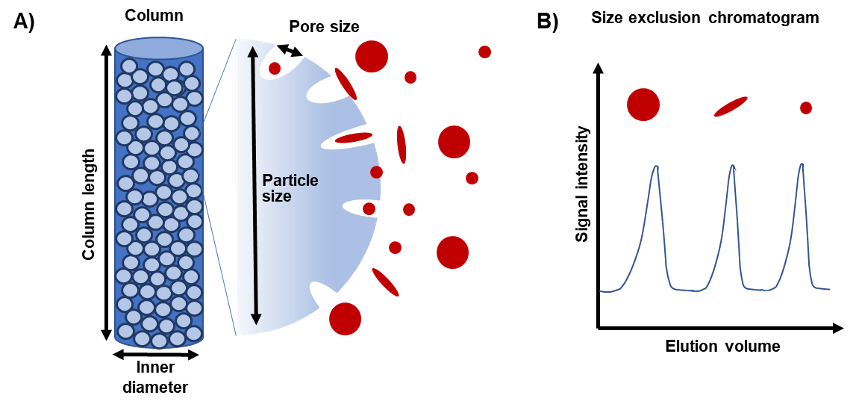
Size Exclusion Chromatography (SEC) columns separate molecules based on size. They consist of a column housing filled with porous particles that separate molecules of different sizes by exploiting the varying diffusion volumes accessible to large and small molecules. The variety of SEC columns is huge and they include gel filtration columns (GFC) for aqueous conditions, gel permeation columns (GPC) for organic conditions, columns with different dimensions and performances for HPLC, UHPLC, FPLC and purifications.
How SEC works
SEC uses a porous stationary phase that allows smaller molecules to enter the pores while larger molecules are excluded and elute first.
- Separation is based purely on molecular size, not charge or hydrophobicity.
- Compatible with aqueous and organic mobile phases for different applications.
Characteristics of an SEC column and how it separates
What SEC is used for
- Aggregate analysis in protein therapeutics such as monoclonal antibodies
- Molecular weight (distribution) determination of proteins and polymers
- Quality control in formulation and stability studies
- Analytics in protein processing
What Tosoh offers
- SEC columns for aqueous separations (proteins, mAbs, ADCs)
- GPC columns for organic separations of synthetic polymers
- Wide range of pore sizes (12.5 nm - >100 nm) for different molecular weight ranges
- Wide range of particle sizes (2-17 µm) for UHPLC separations, semi-micro applications and up to preparative separations
- Proven reproducibility and long column lifetime
- 50 years of expertise and technical/applications support a phone call away
Right column.