Abstract:
For downstream processing in biopharmaceutical manufacturing, improving productivity while reducing cost and environmental impact remains a key objective. Process intensification strategies have the potential to address these needs, although their broader adoption is often limited by uncertainty around implementation effort and realized benefits.
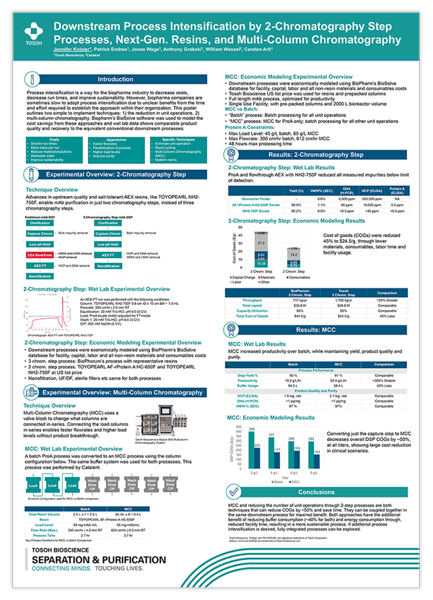
In this study, two intensification approaches were evaluated: reduction of unit operations and implementation of multi-column chromatography (MCC). These strategies were assessed using a novel economic modeling algorithm, incorporating facility, labor, capital, and consumable costs. A conventional three-step chromatography process was compared to a simplified two-step process, with experimental studies indicating comparable product quality and recovery.
To further examine performance gains, a batch Protein A step was adapted to an MCC configuration, enabling higher flow rates and increased loading without product breakthrough.